Mental Health Awareness Week 2018

We’re coming to the end of mental health awareness week and it’s been a great chance to raise awareness of mental wellbeing as well as ill-health, which is what people often think of.

I wrote a short piece for the British Association for Counselling and Psychotherapy on how not being able to talk about feelings adversely affects men and boys.

Https://www.bacp.co.uk/news/2018/may-2018-mental-health-awareness-week/may-2018-men-and-stress/

Many men have expressed their surprise at how easy it is to talk in the counselling room, given a skilled listener. All too often we take on board cultural messages about men not needing to be listened to, that they should be able to work things out on their own.

Let’s not give our sons these damaging and isolating messages, listen to them, encourage them to open up, to share with trusted friends and family.

5 Principles to a Stronger Relationship

Thanks to David at Select Psychology in Tynemouth who asked me to write a short piece for their website for Valentine’s Day. I thought it was the least I could do in recognition of all the fresly brewed coffee and teapigs green tea he lets me drink there!

I’ve seen many couples for relationship therapy over the years: some have managed to part with a better understanding of why they found it so difficult to sustain a loving relationship, while many leave grateful for the opportunity to deepen their relationship and move to the next level of togetherness as a result of facing difficulties.

I’m a Relate trained therapist, and also a big fan of the Gottman Institute’s work in researching thousands of real couples since the 1970s (https://www.gottman.com/about/research/) as I believe it’s important to base therapy on a sound evidence base. I’m a bit of a relationship geek and actually enjoy reading research papers!

Four of the principles from the Gottmans’ work that I find myself using all the time are included in their book ‘The Seven Principles For Making Marriage Work’ and their ‘Sound Relationship House’, both of which can be easily found online.

69% of conflicts go unresolved: not every disagreement has to be worked through and many successful couples never address 69% of these. Make it a rule to consciously choose which conflicts are worth working on together and which are not important.

5:1 ratio: often when couples come to see me they’ve become frustrated because in trying to improve the relationship they’ve got to a point where every interaction is negative. This is an easy trap to fall into because humans naturally focus on problem solving, but research shos that every negative or problem solving statement needs to be balanced by at least five positive ones. I think of it like vaccinating your relationship in advance of the bugs of life!

Love Maps: often when we date we stay up all night talking and finding out about our partner, but when things become more familiar we forget our partner is changing all the time. Making time to find out how their day went, whether their favourite colour has changed, where they would love to go on holiday helps to build a shared foundation for togetherness.

Turning Towards, not against or away: when conflict calls there are two really unhelpful ways to manage things, you can fight, or you can run away. The only successful way of managing differences of perspective in a relationship is to turn towards each other in calm moments and find ways to speak and hear each other respectfully and with empathy.

In addition to these, in ‘Romancing the Shadow: A Guide to Soul Work for a Vital, Authentic Life’ Connie Zweig and Steve Wolf write about the relationship as being the ‘third body’ that needs to be nourished. I prefer to think of a relationship as a garden that grows between two people. If one (or both) parties neglects the garden then weeds and pests will quickly invade the space and take over, but if both people make space and time to cultivate their shared garden it will flourish and grow as they would wish.

+++++++++++++++++++++++++

Armele Philpotts is a relationship and family therapist working at Relate and privately in the North East of England. She is a member of the British Association for Counselling and Psychotherapy and the Association for Family Therapy

Are you due a Relationship MOT?

I like the idea of harnessing routine in a relationship, the power of making small regular deposits into the relationship ‘bank account’ that over time serve to build a strong foundation: when I say goodbye to my clients at a final session I often suggest they choose a future date in their diary to review what progress they’ve made and stay aware of any small issues that threaten to grow.

So making a yearly date to sit down  to look at your relationship makes sense: often we’re so caught up with work, kids, family, friends that focussing on where our relationship is just doesn’t get a look in. Looking back on an average year for me I could assure you that enough will have happened that’s been completely out of my control that a bit of time out to thrash things out and make sense of things with my partner is usually long overdue.

If you’re single you could do this with a good friend, and return the favour, or of course make use of an experienced and qualified relationship counsellor (try www.counselling-directory.org.uk “.. a comprehensive database of UK counsellors and psychotherapists, with information on their training and experience, fees and contact details.”)

Some questions to ask might be:

What’s important to me in this relationship?

Is this being honoured at present?

Am I being the person I want to be currently in this relationship? If not, why?

If I am, what could I do more of?

What would my partner like less / more of?

Can we talk openly and honestly, even when the subject is sensitive?

How is our sex life?

I’d love to hear your thoughts on the idea of a relationship MOT .. message me below or get in touch on Twitter or email me.

How Grateful Are You?

poppies bannerNovember has been designated a month for Gratitude in both the USA and Britain for different reasons. In Europe we have a Day of Remembrance on the 11th and as we see the Remembrance poppies gradually appear on our streets we are reminded of ordinary people just like us who gave their lives so that we can live in peace.

Gratitude and giving thanks are incredibly powerful mindfulness practices that we can use in our lives to increase our wellbeing and nourish relationships. It’s easy to be grateful when things are going well, and equally as easy to let this slip when life takes over or gets challenging. This of course is when we need to flex our gratitude muscle the most.

Sharing our gratitude with others is so important and research in the field of Positive Psychology shows that we are more likely to feel and express gratitude when shown kindness by a stranger than towards those whose lives we share:

When was the last time you thanked your partner for being there for you?!

How do you think they might feel if you took that one step towards them?

For the past twenty years I’ve been marking each November by re-focussing on my daily gratitude practice, and more recently I’ve been using the power of social media to keep myself on track. Making a pledge to post something different that I’m grateful for every single day of November on Twitter or Facebook really helps get me back on track!

This year I’m using Instagram to give myself the extra little challenge of finding a nice image to go with each reflection. If you fancy following me you can check if I manage it, and I’d love you to join in! Or if you prefer to receive prompts there’s an online 30 Day Gratitude Challenge (not run by me) that you could sign up for .

And of course gratitude goes hand in hand with Kindness. There are lots of groups and projects springing up around kindness and compassion, with an excellent Facebook group in my area of Tyne and Wear that encourages members to both carry out and notice acts of kindness in their everyday lives.

So go ahead and try it, ask yourself once a day every day of November .. what am I grateful for right now?


Gratitude-Month

References
Gratitude and Positive Psychology: What is Gratitude and What are the Benefits of Gratitude? Meade, Claire. http://positivepsychology.org.uk/gratitude/ accessed 8 November 2017.

We’re Separating .. Help!

Separation and Divorce are tough, whatever the circumstances surrounding them. Sometimes a couple come to the decision to part ways together; more often one person makes the decision, and in some cases the other person has no idea their partner is unhappy in the relationship until the point at which they make the announcement they want to leave.

separation .. get support

Usually, adults are trying to make important practical decisions that will impact their future while also managing the strong emotions that are completely normal when we go through big changes in our lives.

You might be okay with your decision to leave the relationship but be confused because you’re finding the other changes around the separation a challenge. Things like the loss of your home, a dual income, your pets, seeing mutual friends, or the status of being ‘a couple’. And when other factors like affairs and looking after children are added into the mix sometimes it can feel like being on a rollercoaster.

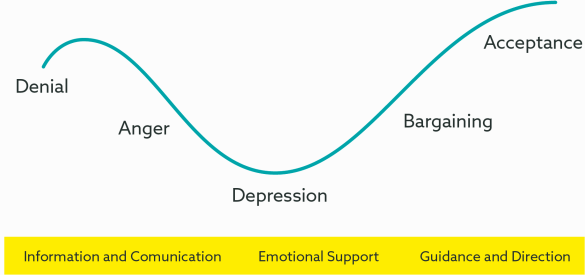
When we go through any change there are stages we have to navigate. In the example above someone may have reached the end stage of Accepting that for them the relationship is over but still be right at the start of processing the other changes. Their ex partner on the other hand could be in Shock and Denial that the couple relationship is at an end, but be further ahead in coming to terms with the more practical aspects of the separation. People need different kinds of support as they go through the different stages, and if you feel you’re stuck in one of these stages it’s a good idea to ask for help.

losscycle

When ex partners are at different stages in this Cycle of Change practical negotiations can often get stuck, as one or both people bring their hearts to the table as well as their heads. This is why I hear often that mediation has been tried early on and failed because one or both partners just aren’t in the right place emotionally.

The challenge is to get to a place where although a couple relationship has ended, a productive relationship as exes has begun.

Making decisions around your children

In an ideal world parents will still be able to communicate together to make important decisions for their children. The Parenting Plan created by CafCass is a really useful tool that maps out most of the important choices parents have to make during childhood. Printing one out each and considering what choices you would like for your child can be a great way to prepare in advance for parenting discussions. Particularly consider WHERE those beliefs are coming from:
Is it because I had/didn’t have that?
Is that choice relevant/appropriate to MY child’s situation?
What can I compromise on and where can I give ground?

iStock_000026753240Medium

Mediation can be a good next option when both parents are willing to negotiate but talking together might still feel tricky. Agreements made in mediation can be court stamped if parents believe this is necessary.

Collaborative Law focusses on working together with specially trained solicitors for a mutually beneficial result, and acknowledges that often people need to work through their normal emotional responses to the separation in order to move forward. It avoids the expense, disruption and emotional distress of going to court.

And never forget that however difficult things may be, the best way to look after your children during any kind of stress and disruption is to LOOK AFTER YOURSELF. Talk to friends, family and / or a counsellor, get exercise, eat well and rest when you need to. Put limits around the emotional energy you give to the situation.

And never forget to hold HOPE for the future. One day the storm clouds will part and you will see the good work you’ve done paying dividends.

More Resources

Sorting out Separation is part of the Government’s help & support for separated families initiative  . https://www.sortingoutseparation.org.uk/

The Parent Connection . Information about parenting after parting . https://theparentconnection.org.uk/

If You Want Great Sex with a Woman Read This!

zoey-kneesAs a relationship coach and counsellor I think about sex A LOT. I talk about sex all the time with my clients, my colleagues and also (excruciatingly for some) with random people in my life.

Research shows that couples who are constantly exploring ways to make sex more pleasurable are five times more likely to be happier in their relationship and 12 times
more likely to be sexually satisfied.

I can’t speak for my generation but my sex education in the 1980s was poor: what little information there was came with a large side of shame, and (no wonder) by Year 11 I heard reports of girls being sexually assaulted and girls disappearing from class due to teen pregnancies.

So my sexual education came from family, my sexual partners, peers, books and magazines, as well as A LOT of studying academic research papers since I became a relationship therapist. BTW if you fancy a bit of light relief or a cheeky gift for a loved one I’d recommend Bonk, by Mary Roach, a hilarious look at how awful a lot of sex research has been.

And I read about and saw the ‘pornification’ of culture and I worried about how our kids, with no coherent national sex education strategy, are learning about sex from porn. Girls and boys are being told sex isn’t about mutual communication and trust, but about male pleasure, thrusting and violence. And both sexes are suffering. In my practice I speak with couples where ‘normal’ sex means 5 minutes with the lights off, and with young couples where use of porn from an early age has caused premature ejaculation or porn addiction.

This slideshow requires JavaScript.

And then along came OMGYES, a sexual pleasure research website. After hearing about the site I was dying to have a good look and I was lucky enough to be offered a preview.

The team behind the site carried out research with more than 2,000 women, aged 18-95, and created a website where real-life women – not actors – share their stories and demonstrate their techniques. Then, users get the chance to practice through touchable simulations.

Because .. different strokes suit different folks ..

The topic has been so taboo that even scientists hadn’t studied the specific, various ways of touching that feel good for different women. I can actually vouch for how taboo because none of the four people I asked to anonymously comment on the website for this article felt comfortable doing so .. just wow!
SeasonOne

OMGYES is for women and the people who love them (approximately 50% of users are female/male). Women can use the site to explore more ways to touch themselves and guide their partners, while partners are adding new, research-based tools to their toolbox.

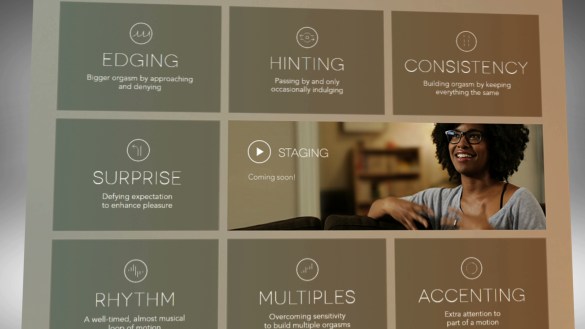
Fifty videos are organised in 12 sections (pictured above) and for a one off payment you can access the site as often as you like, watching videos in any order and at your own pace. The site also uses tech to the max, with touchable demos where users can practise what they’ve learned (useful if you don’t have a vulva guys!). I found the site ran a bit slow on my (very old) tablet, but on the laptop it was fine.

I was expection the site to be purely about technique, and it was a pleasant surprise to find sections on ‘Framing‘ and ‘Signalling‘ .. those hugely important bits of sex that happen in our brains and come out of our mouths.

beige+white_logo

I’ve been recommending this site to clients and colleagues, in fact I might have become a bit of an OMGYes bore, but beauties like this don’t come along every day. I’d recommend it for single women as well as women in a relationship, and when the time comes I’ll be recommending it to my daughter as part of an ongoing conversation about what she should expect from sexual maturity.

To learn more, visit the website at omgyes or follow them on Facebook and Twitter. And tell me what you thought of OMGYes .. email me or contact me through the website.

Mindful Relationships

I was lucky enough to be asked by the lovely people at The Counsellors’ Cafe to write a piece of my choice and I chose Mindful Relationships, because as a practising Buddhist it’s something that I apply to my relationships and to my work as a relationship therapist.

It was fun writing the piece as it gave me a chance to pull out some useful resources for people from the many I’ve collected over the years on being mindful in relationships mindful parenting and mindful families.

Go take a look and let me know what you thought below, or on the Counsellor’s Cafe comments area.

I’m also very excited to be part of the first Mindful Relationships Summit, an online conference from 17 to 21 May 2017 about  how we can create and sustain mindful relationships and embrace love as a spiritual practice. Some of my favourite speakers on mindfuless and relationships like Susan Piver, Rick Hanson and Dr Kristin Neff will be there.

It’s absolutely free and it would be great if you’d consider joining me.

Lotus

Calling Scottish Couples

I had to blog about Relationships Scotland’s current project: they’re looking for couples to take part in a couple counselling documentary.

The charity say on their website .. “.. we are interested in dispelling myths about relationship counselling and, where appropriate and with permission, telling the real life stories of the couples we support.”

zodiak

Relationships Scotland are working with Zodiak Media on a new six part series following couples through the process of relationship counselling.

They plan to look at the very different issues that bring people to couples therapy, with couples across age groups and in different stages of their relationships, with the intention of removing stigma around couple counselling. Hopefully the project will show that therapy is something many couples could consider to improve their relationship before it reaches crisis point.

Both of these goals are hugely important: statistics and my experience suggest that if many couples accessed counselling earlier they would save themselves a lot of money and heartache by looking at making small changes that would make big differences in the quality and trajectory of their relationships. I personally am a strong believer that universal funding for short courses of relationships education and therapy at key stages, like high school, making a commitment, having a baby, moving to an empty nest and retirement would improve wellbeing throughout our nation now and for future generations.

Relationships Scotland’s next step is to find appropriate Scottish couples willing to discuss the opportunity further – they stress that there is absolutely no commitment at this stage.

If you would like an informal chat about taking part please email Ross McCulloch, Head of Communications at Relationships Scotland, ross.mcculloch@relationships-scotland.org.uk or call 0845 119 2020.

I’ll be keeping an eagle eye out for the documentary when it comes out. What do you think, will this project be realistic and / or useful?

Babyproof your Relationship

Becoming parents is a marvellous time for many couples, and for others it can be rough, even leading to relationship breakdown.

birth and baby basics The lovely Janine Rudin over at Birth and Baby Basics asked me to write a couple of articles on preparing your relationship for the birth, as well as ideas on how to manage things afterwards.

Janine is an inspiring antenatal teacher, doula, baby massage instructor and postnatal educator, who’s been providing a unique combination of professional support and services from pregnancy through to life as a young family on Tyneside since 2008.

I’m lucky enough to be a mother, but when my baby arrived it was by no means plain sailing. At times it felt like my husband, new baby and I were in a tiny boat on very stormy seas. We had very little support close by at that time and I suffered from post-natal depression. Eventually my marriage broke down, which at the time was really tough, but gave me the motivation to heal, as well as learn how to help others who might be in a similar position.

Go and take a look at Janine’s fab Birth and Baby Basics website and see what I wrote here .. and here.

——————————-

I would love to hear what you think about becoming a parent? Did you struggle? Any tips? Any hopes or worries you’d like to share?

Do get in touch by Commenting below or using my Contact details to speak direct.

Gratitude

“Feeling gratitude and not expressing it is like wrapping a present and not giving it.”

William Arthur Ward

Something often missing with couples who are experiencing difficulties is gratitude. It’s easy to take for granted all the little things our partners do for us every day and focus on the things they do wrong, the dishes in the sink, the unmended cupboard door .. but what if we take a moment to think about all the things they are doing right?

Since 2000 scientists have been finding that people who practice gratitude consistently report a host of benefits:

Stronger immune systems and lower blood pressure
More joy, optimism, and happiness
Feeling less lonely and isolated

Gratitude has two key components: firstly it reminds us that there are gifts and benefits we’re consistently receiving from our partner and those around us.

Robert Emmons, perhaps the world’s leading scientific expert on gratitude, writes “I see it as a relationship-strengthening emotion, because it requires us to see how we’ve been supported and affirmed by other people.”

The second part of practising gratitude is to express it, to acknowledge the other people who give us so many gifts, big and small, to help us achieve the goodness in our lives each day.

November is Gratitude Month, and I will be marking each day of this month by keeping a gratitude journal, noting down something different each day and meditating on it.

To start your gratitude practise, take just a few minutes each day to think of at least one thing you’re grateful to your partner for .. take note, some days this will be easier than others! ;-D

Once you’ve got this down find creative ways to let your partner know how much you appreciate what they do .. a hug and a thank you, or a note left in their lunch box to find at work?

This can also be a good exercise when you’re frustrated with your spouse and about to explode! Take some time out to remember what they do for you, and when you’re ready to face them start off by reminding them how much they do, before letting them know that broken cupboard door is driving you crazy!

– – – – – – – – – – – – – – – – –

I love to hear what you think about the topics raised in my blog, and how you apply these in your life. Do leave Comments below or get in touch using my Contact details.